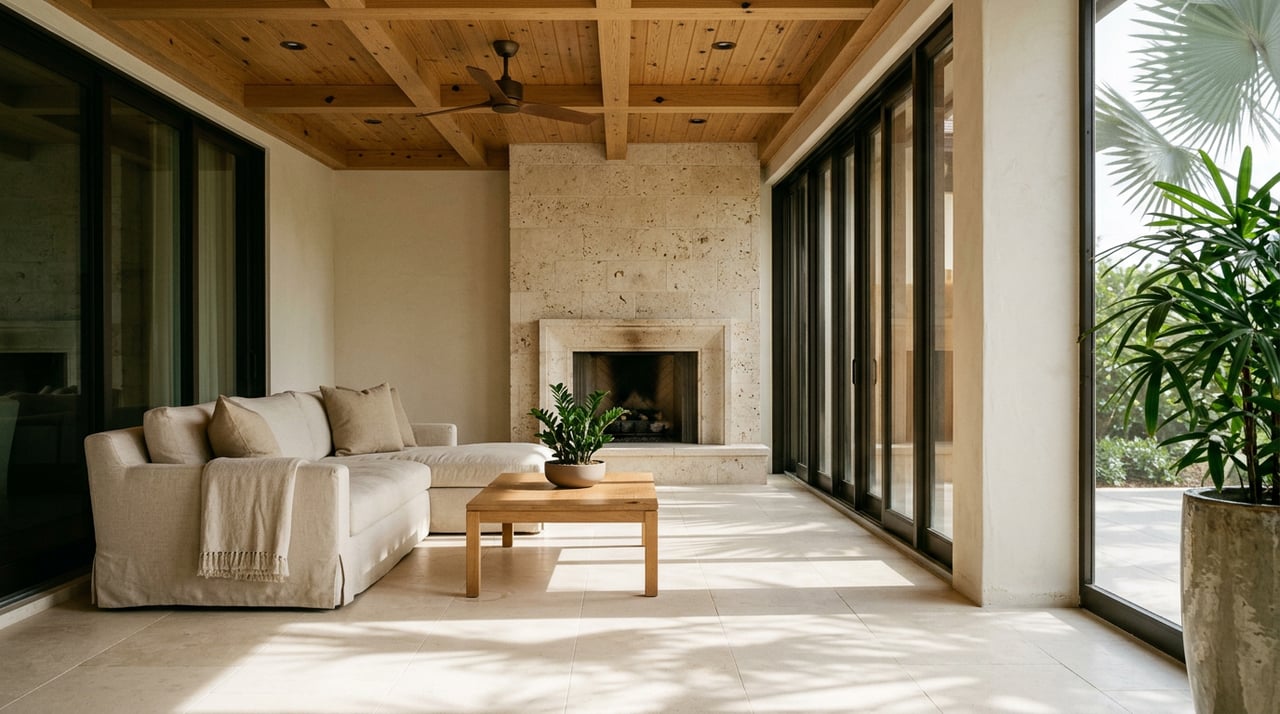
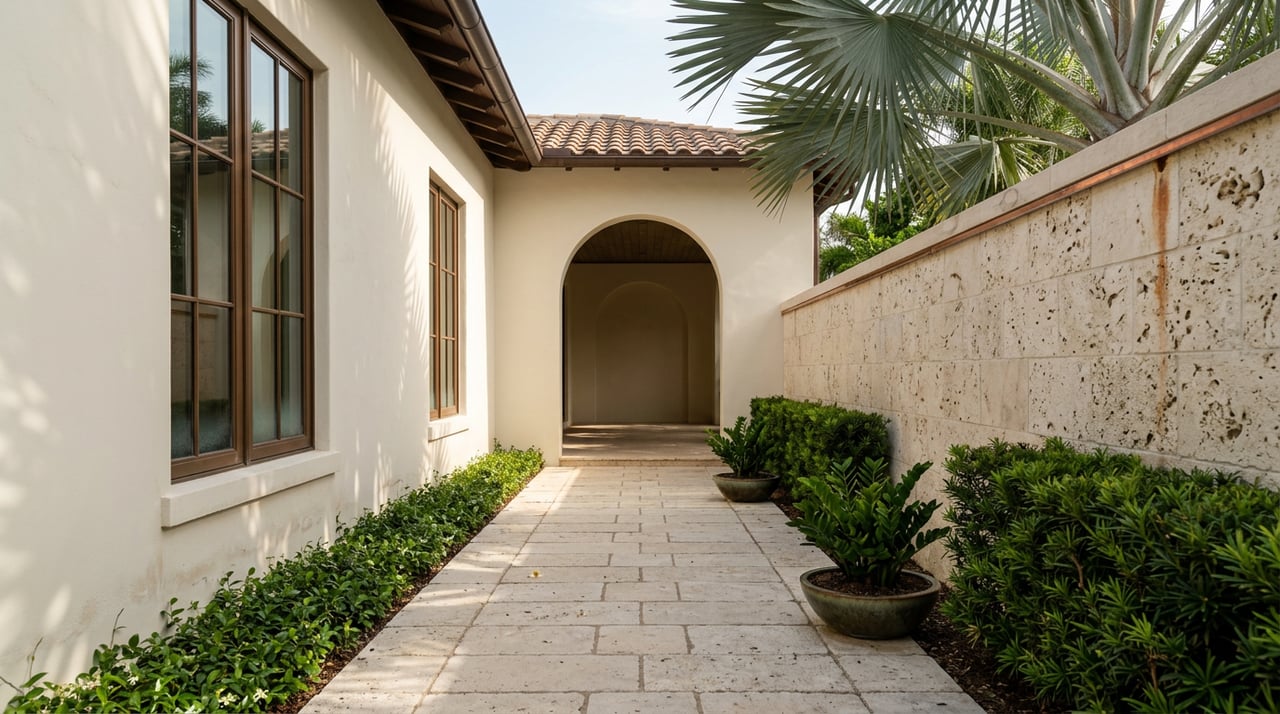
Two homes can share a Port Royal ZIP code, sit within a short walk of each other, and trade at very different numbers. The listing sheets will call both of them "Port Royal." The parcel records will disagree.
That disagreement is the market. Buyers who read Port Royal listings as a single product are pricing an address. Buyers who read them as a bundle of parcel rights are pricing what the neighborhood actually sells, which is the deeded ability to activate a membership at the Port Royal Club within ninety days of closing. Miss that window, or buy the wrong lot, and the premium the market pays for eligibility is not something a future renovation can restore.
The map is the first filter
Port Royal Club membership is not a social application. It is a right that travels with specific parcels of land, and the geography is narrower than the neighborhood boundary. Eligibility runs to properties south of 21st Avenue South and Palmer Estates, which excludes a meaningful share of homes that a buyer would still reasonably describe as "in Port Royal." Two lots on either side of that line can carry identical waterfront depth and identical curb appeal, and only one of them will offer the Club right at closing.
The pool of eligible parcels is finite by design. The Club is structured around roughly 700 memberships, and because those memberships are tied to land rather than people, the cap is enforced by the survey, not by an admissions committee. That is the mechanism a buyer is really paying for when a listing says "Club eligible." It is scarcity written into the plat.
Little Harbour, the guard-gated 32-homesite enclave along Gordon Drive between Port Royal and Aqualane Shores, complicates the picture. Some residences there carry full Resident eligibility. Others carry Associate eligibility, which behaves differently at the closing table. Reading a Little Harbour listing without confirming which category the parcel falls into is the single most common way a buyer misprices this stretch of Gordon Drive.
The ninety-day clock is where value is made or lost
The transaction friction that catches out-of-market buyers is not the price. It is the calendar. Within ninety days of closing on a Resident-eligible property, a new owner has to choose one of three paths, and each of them prices differently on a future resale.
| Post-closing choice | What it costs at the ninety-day mark | What the parcel carries forward |
|---|---|---|
| Become a full Member | Full joining payment plus current annual dues | Active membership, full amenity access |
| Reserve eligibility for up to five years | 25% of the current joining payment plus 25% of annual dues, paid yearly | Resident eligibility preserved, no amenity access during the reserve period |
| Elect neither | Nothing at ninety days | Membership eligibility suspended; a future owner faces a reinstatement fee equal to 75% of the current joining payment |
That third row is the one that quietly rewrites the value of the home. A suspended parcel is still on the correct side of 21st Avenue South, still on the deed, still on the plat, and still visibly a Port Royal home. What it no longer offers is a clean activation for the next buyer. The 75% reinstatement figure is priced against the current joining schedule, not the schedule in force when the seller closed, which means a lapsed parcel takes on more downside as the Club's fee structure moves upward.
The reported joining payment has been climbing. Secondary sources cite a $315,000 figure moving to $400,000, with annual dues reported near $16,200 plus tax, all subject to change. Any buyer writing an offer this year should treat those numbers as directional and confirm the current schedule directly with the Port Royal Club membership office before the inspection period ends. The fee is a moving line, and it moves in the direction that penalizes a lapsed parcel.
The Associate Waitlist is not a shortcut
Buyers who fall for a home north of the eligibility line sometimes ask whether the Associate Waitlist is a workaround. It is not. The waitlist is a queue for eligible-adjacent owners to be invited to join, and a non-refundable $10,000 plus tax deposit is required to hold a place. That deposit credits toward the joining payment if and when an invitation is issued. Timing cannot be predicted, and waitlisted owners cannot use Club amenities in the interim.
For a mid-funnel buyer weighing a Little Harbour Associate parcel against a Resident-eligible Port Royal parcel a few streets away, the practical read is that the waitlist buys a place in line rather than an amenity. That distinction matters when the reason for buying in Port Royal is the Club itself.
Reading the January 2026 numbers through the eligibility lens
Port Royal recorded roughly $696.3 million in closed dollar volume for the twelve months ending January 2026, up 106.8% year over year in the William Raveis luxury reporting. Average closed price landed near $23.51 million in the same window, and a single Port Royal transaction at 4296 Cutlass Lane closed at $55 million on January 14, 2026, reported as the top United States home sale for the month. Cash represented 67% of Naples sales in January 2026 in the NABOR data.
None of those numbers, on their own, tell a buyer why one Port Royal home clears at a premium and the next one lingers. Eligibility does. When 67% of purchases clear without a lender, the marginal buyer is not price-sensitive in the traditional sense. That buyer is sensitive to friction. A parcel that presents a clean, verifiable Resident eligibility path with the ninety-day activation intact is the low-friction product. A parcel with lapsed eligibility, or with an Associate designation the seller has not clarified, is the higher-friction product, and the price gap between them is not visible in the neighborhood-level median.
Months of supply across the 34102 ZIP code has tightened, reported at a compression from 29.54 to 13.80, even as days-on-market extended. That combination reads as inventory selectivity rather than a broad slowdown. Buyers are willing to wait for the right parcel and unwilling to overpay for the wrong one. Eligibility status is the variable that separates the two.
The clubhouse rebuild and what it means for closings this year
After Hurricane Ian in September 2022, the membership approved a ground-up $100 million reconstruction of the beachfront facility rather than a restoration of the 1959 structure. The new clubhouse is a 62,000 square foot, two-story building at 2900 Gordon Drive, with an expected completion in the second half of 2026.
For a buyer closing this summer, the practical implications are two. First, the reserve option looks different when the amenity a buyer is reserving is a facility that has not yet opened. A 25% reserve payment made this year is a bet on the delivered building matching the renderings, on the target completion window holding, and on the joining schedule at the time of activation. Second, sellers who preserved eligibility through the construction period are bringing a cleaner product to market than sellers who did not. The rebuild is a filter that has already sorted the inventory.
Due diligence a buyer should complete before the offer
The items below belong in the inspection period, not after it. Each one has surfaced as a transaction risk in this market.
- Written confirmation from the Port Royal Club membership office of the parcel's eligibility category, current status, and any prior lapse in the chain of title
- Current joining payment schedule and annual dues in writing, dated within the inspection window
- Title and closing attorney review of the recorded documents that carry the eligibility right, since the Club plan and bylaws are the definitive authority
- Lender confirmation, if financing any portion of the purchase, on how the institution treats value tied to non-real-property membership rights
- CPA review of joining fee and dues treatment for the buyer's specific tax posture
- Seawall, dock, and coastal permitting history for the parcel, given the depth and width of Port Royal's canal system and the size of vessels the frontage will accommodate
- Confirmation of the eligibility category for any Little Harbour parcel, since Resident and Associate designations coexist inside the same 32-lot enclave
The offer contract can be written to make the sale contingent on written confirmation of transferability and current fee schedules, with fees escrowed pending final Club confirmation where the timeline calls for it.
Frequently asked
If the parcel is south of 21st Avenue South, is it automatically eligible? Not automatically. The geographic boundary is a necessary condition, not a sufficient one. Deeded rights and prior owner elections both matter, which is why the membership office confirmation and the title review are separate items.
Can a suspended eligibility be reinstated by a future buyer? Yes, at a reinstatement fee reported at 75% of the current joining payment, which is the schedule in force at the time of reinstatement rather than the schedule in force when the parcel was suspended.
Does the Associate Waitlist deposit convert to a full membership? The $10,000 plus tax deposit credits toward the joining payment if and when an invitation is extended. There is no guaranteed conversion and no predictable timeline.
Is the Club open year-round? The facility closes for a month in mid-summer and reopens in mid-August, which is a seasonal detail worth factoring into a closing calendar if amenity access is time-sensitive.
Port Royal rewards buyers who read a listing as a bundle of parcel rights rather than as a price per square foot. If a specific home is on your shortlist and you want the eligibility status, the joining schedule, and the transaction structure confirmed before you write, Mark Paige Riley at Lux International Properties can walk the parcel with you. Let's connect.